On Names
An extension and prelude

This is the third of what is now a series about naming. Previously, I talked about our obsession with shortened names here in Singapore. Today I touch on names of roads, places, and people. The last section on pinyin is a lead-in to my next post on hawker stall names and the stories behind them.
Singapore has always had a tenuous relationship with naming and languages. We're technically 57, but there is no consistent naming system in the city.
The good ole' days
Our naming conventions go way back to the colonial era, with traditional go-tos like Queen Street, King's Avenue and Duke's Road. Roads were also named after people – Shenton Way (Governor), Henderson Road (botanist, curator), and Braddell Road (Attorney-General).
In the 1960s, the Street-Naming Advisory Committee was charged with eliminating "old colonial nuances, British snob names, towns and royalty" and was encouraged to use Malay names instead. That's how Jalan Satu and Jalan Dua, both at the Old Airport Road area, came about. Unfortunately, such attempts were met with much resistance. The public preferred English road names, because they were seen as "neutral".
1, 2, 3...
Less than a year later, the SNAC made an about-turn and stopped using Malay for street names. This was 1968, and perhaps they wanted something more neutral after Separation. So they started using numbers: Lorong 1, 2, 3... It seems like they felt very comfortable with this system, because it persisted for many years, till Pasir Ris, one of the newer towns, was built. However, roads in Goldhill Gardens, a small estate in the Thomson (Chief Engineer) area, switched from the numerical system back to a more atas one: "Goldhill Avenue, Rise, View, Drive".
Multiracialism
It is an uphill task to accurately reflect a multiracial and multilingual landscape of a country. The Jurong (either Jerung: shark or Jurang: gorge, or Penjuru: corner) Town Corporation (JTC) faced such a challenge when they were developing their namesake area. They wanted a good mix of names, but because many investors were Chinese, Chinese road names ended up taking a larger share of the pie. There still were Malay road names, like Jalan Tukang (skilled craftsman) and Tamil ones, like Neythal Road ('to weave' [textiles]).
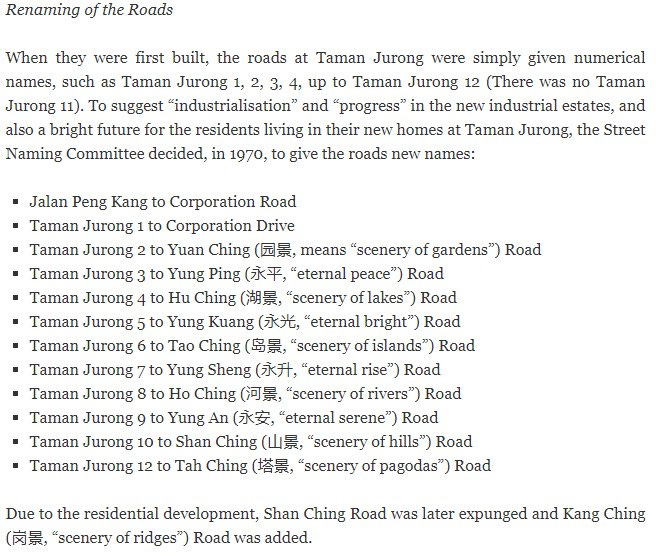
(This might be a screenshot from Remember Singapore)
Pinyin 'revolution': places and roads
In 1967, the government spent three whole years translating all local street names to Chinese (Cantonment Road: 广东民路, anyone?) But perhaps the worst linguistic decision the government made was in the 1980s, and I'm not talking about the Speak Mandarin Campaign. It happened when they became huge fans of the hanyu pinyin system. Every Chinese character has at least one corresponding pinyin word and one of the four tones. (Hanyu pinyin was just better, and easier, right...? Not.) So they started renaming places. The famous Tekka Market at Little India is often cited as an (insane) example. "Tek (竹) Kah (脚)" in Hokkien means "under the shade of bamboo trees". The government, in its quixotic effort to standardise everything, decided to call it Zhú Jiǎo Bā Shā. Sounds familiar? Maybe you are a fan of pig trotters. Nee Soon Road, which was named after rubber baron Lim Nee Soon, became Yishun. (Sounds like erasure to me.) Although they changed course shortly after (see: the present Nee Soon GRC), the Yishun name lived on (most prominently, on the MRT station).
Pinyin 'revolution': people
You know what really stuck around? People's names. Alongside the Speak Mandarin Campaign, the state coaxed Chinese parents to use hanyu pinyin names for their children. This is also why our report books have a field for "hanyu pinyin name" – it was ostensibly to allow teachers to pronounce students' names better.
Now we have an entire generation (roughly 40 to 50 per cent) of 80s-born Chinese Singaporeans with hanyu pinyin names only. These children would not take their father’s surname. They would be Liu in lieu of Lau; Chen instead of Tan. They would be Yao instead of Ngeow. Nevertheless, some parents continued to use dialect names for their children during that period of time – I believe the figure is around 10 to 20 per cent.
After a while, things went back to a sort of equilibrium. There would be a mix of names: pure dialect names, like Tan Boon Seng George; pure hanyu pinyin names, like Lin Yì Fāng Andrea; or hybrid names, like Wong Shū Fēn, Christine.
Mini-conclusion
I wanted to write about the naming of Chinese hawker stalls in this post, but my research sent me in a different, but familiar direction. Next time, I’ll talk about hawkers – their dialect group background and how they named and renamed their stalls over the past few decades.
If you take away one thing from this post: names are important. They tell us about someone or something; they encapsulate the "essence of a[n]... entity" (Tan, 2021).
Names mean something to the general populace. This is compounded when residents have lived there for a very long time. If you suddenly rename their Circular Road as Pesiaran Keliling, or Jalan Layang Layang to Swallow Road, I’m not sure they might be comfortable with it, regardless of their race.
A note on dialect names (of places and people alike) – they reflect a certain heritage and a story, or “典故” that came with the name itself. Rashly switching (or encouraging people to switch) to another system simply upsets the masses. I found the pinyin saga particularly unnerving, because it represented the state’s involvement in something very personal – the name of one’s own child. The family name is a pretty serious thing for older Chinese people. Sure, you could argue that the name lived on in its modern Simplified Chinese script, but it just wouldn’t be the same for those who were proud of their dialect group or just their family name. Think Ng, Wong, Wee, Ooi and Oei. “Pinyinise” them and they’d all just be Huáng. That just doesn’t sit right with me.
Bibliography
Tan, K. W. P. (2021). Naming as styling: Inauthenticity in building names in Singapore. In D. F. Virdis, E. Zurru, & E. Lahey (Eds.), Language in place: Stylistic perspectives on landscape, place and environment (pp. 167-188). Johns Benjamins. doi.org/10.1075/lal.37
Yeoh, B. S. A. (1996). Street-naming and nation-building: Toponymic inscriptions of nationhood in singapore. Area (London 1969), 28(3), 298-307.
Yeoh, B., & Kong, L. (1997;1996;). the notion of place in the construction of history, nostalgia and heritage in singapore. Singapore Journal of Tropical Geography, 17(1), 52-65. https://doi.org/10.1111/j.1467-9493.1996.tb00084.x