Hawker stall names
Substack made me split this post into two parts.

Introduction (or Hook)
I have lived in Tanjong Rhu for 85 per cent of my life. My grandfather, when he was younger, would take morning walks along the park connector to Jalan Batu, then take bus 158 home. (Almost two decades later, he still takes these walks!) When I studied in the afternoon session in primary school, he would buy me wanton noodles from a coffee shop at Jalan Batu1, then cycle home. Because they were acquainted, he would get free soup, even though soup is generally not provided for takeaway orders.
(This coffee shop is noteworthy since it is rumoured that it is not owned by the people running the drinks stall, but by the pau seller. The person running the drinks stall is thus an employee and not the proprietor. (I talk more about the drinks stall operator as kopitiam proprietor in the next post.)
The family running the noodle stall was vaguely familiar to me – I knew there was an old father and his son, a protégé of some sort. He would eventually inherit the business when I entered secondary school. When the hawker centre next door began renovations when I was Sec 1 going Sec 2, the family decided to take up a stall in the hawker centre2, occupying the old dessert stall position at the corner, where they have been ever since. Business was and still is brisk – there is always a long line, starting from about 630 to 7am, till lunch time. The family uses mahjong chips to differentiate customers’ orders, which I found very interesting.
When the noodle stall was at the coffee shop, it did not really have a signboard. There were just a few words in Chinese – Small, $2, Big, $2.50, and another line for their dumpling soup. Later on, when they moved to the hawker centre, they called themselves “Kim Kee [金记] (Coffeeshop) Tanjong Rhu Wanton Mee”.
Focus
This name, along with other Chinese hawker stall names, is my focus today. How do people name their hawker stalls? Why are some names more common than others?
Brief Overview of Hawker Culture
It is unsurprising that hawker culture was added to Unesco's "list of intangible cultural heritage'. But the title “hawker culture” seems like a misnomer, especially among our non-local friends. The word ‘hawker’ implies itinerancy3 – it calls up scenes in old movies and Mediacorp period dramas where men and women with 祝君早安 towels draped across their shoulders hawk their food, preparing kolo mee and char kway teow. Hawkers are not supposed to be centred. They are supposed to run away when the tae gu – a slang term for NEA officials back in the day – arrives to issue warnings and summons.
Nowadays, hawkers of various cuisines are gathered under one roof. Seats are usually sheltered, though there are some hawker centres with open-air dining, like East Coast Lagoon and, surprisingly, Serangoon Garden Food Centre (not to be confused with Chomp Chomp). Hawkers have all the basic necessities, like electricity and piped gas; today, some hawker centres even have conveyor belts at (compulsory) tray return points. Most hawker centres are paired with wet markets (again… not really wet), especially those in the heartlands.
Street hawkers probably did not have their own signboards back in their hawking days. When they moved to hawker centres, it became the norm to have a signboard. These signboards reflected the linguistic and cultural diversity of different dialect groups in Singapore. Furthermore, these names are important to people – it is not uncommon to hear among businesspeople that it is important to come up with an auspicious name – it carries meaning and can be said to embody the stall itself.
Chinese hawker stalls typically have a few common names or Chinese characters. (Note that the majority of Singaporean Chinese are Hokkien or Teochew.) These include:
兴 (xīng)
Heng in dialect
“to flourish”
Commonly paired with 順 - Soon in dialect, shùn in Mandarin - smooth sailing
Other examples: 缘兴 (Guan Heng: fate + flourish), 永兴 (Yong Heng: forever flourish[ing])
发 (fā)
Huat in dialect
prosperity (八 is sometimes used as they sound similar)
Examples: Poh Huat (infusion of surname + auspicious name), Heng Huat
福 (fú)
Hock in dialect
fortune
Example: Hock Seng (see below)
成 (chéng)
Seng in dialect
one half of the phrase 成功, which means success
Example: Soon Seng, Soon Heng
久 (jiǔ)
[for a] long time
记 - Kee in dialect, which is typically attached as a suffix for eateries and restaurants.
If your name is Teo Song Heng (张松兴), 松记 would be a possible option (see photos below)
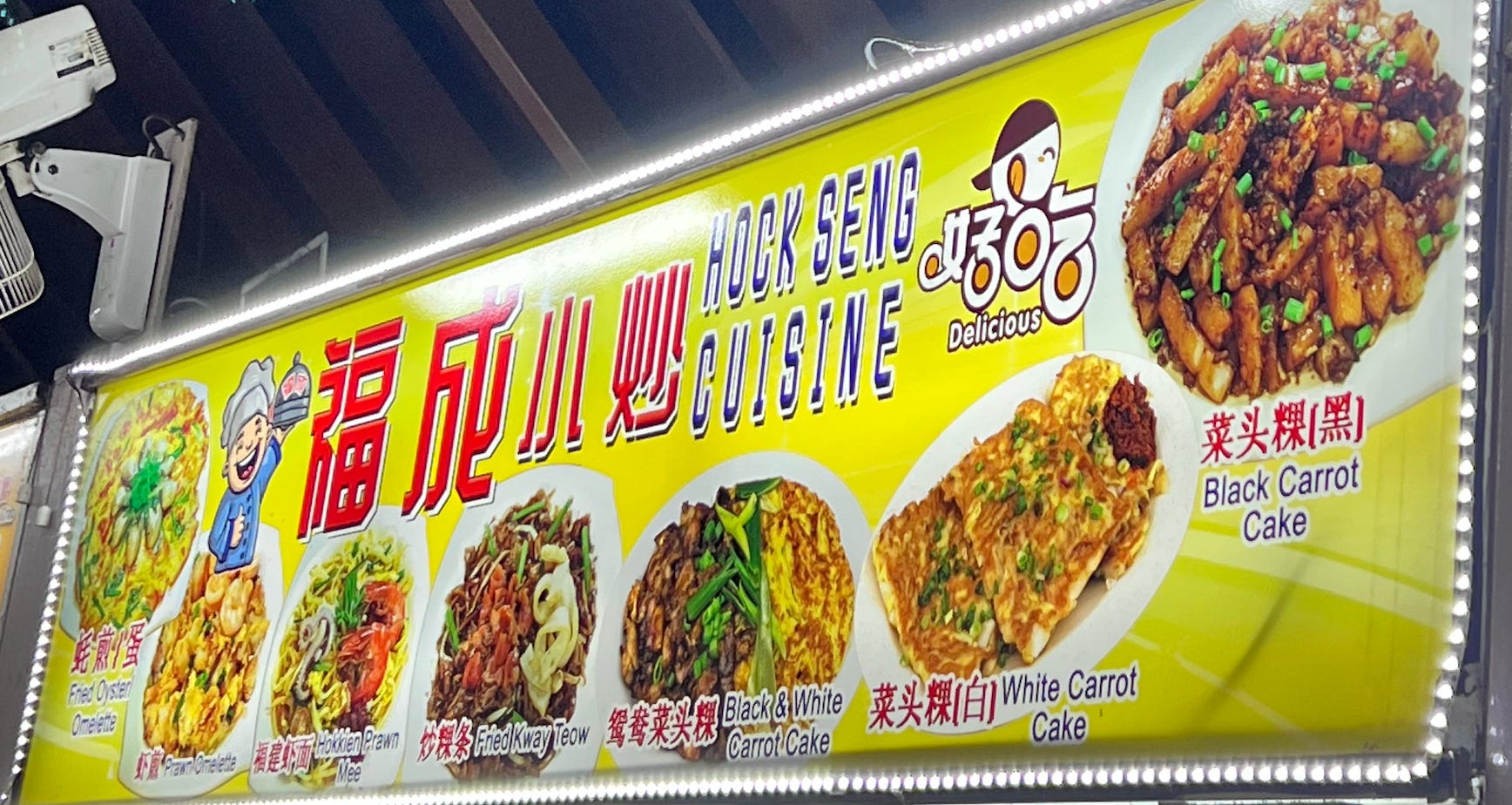
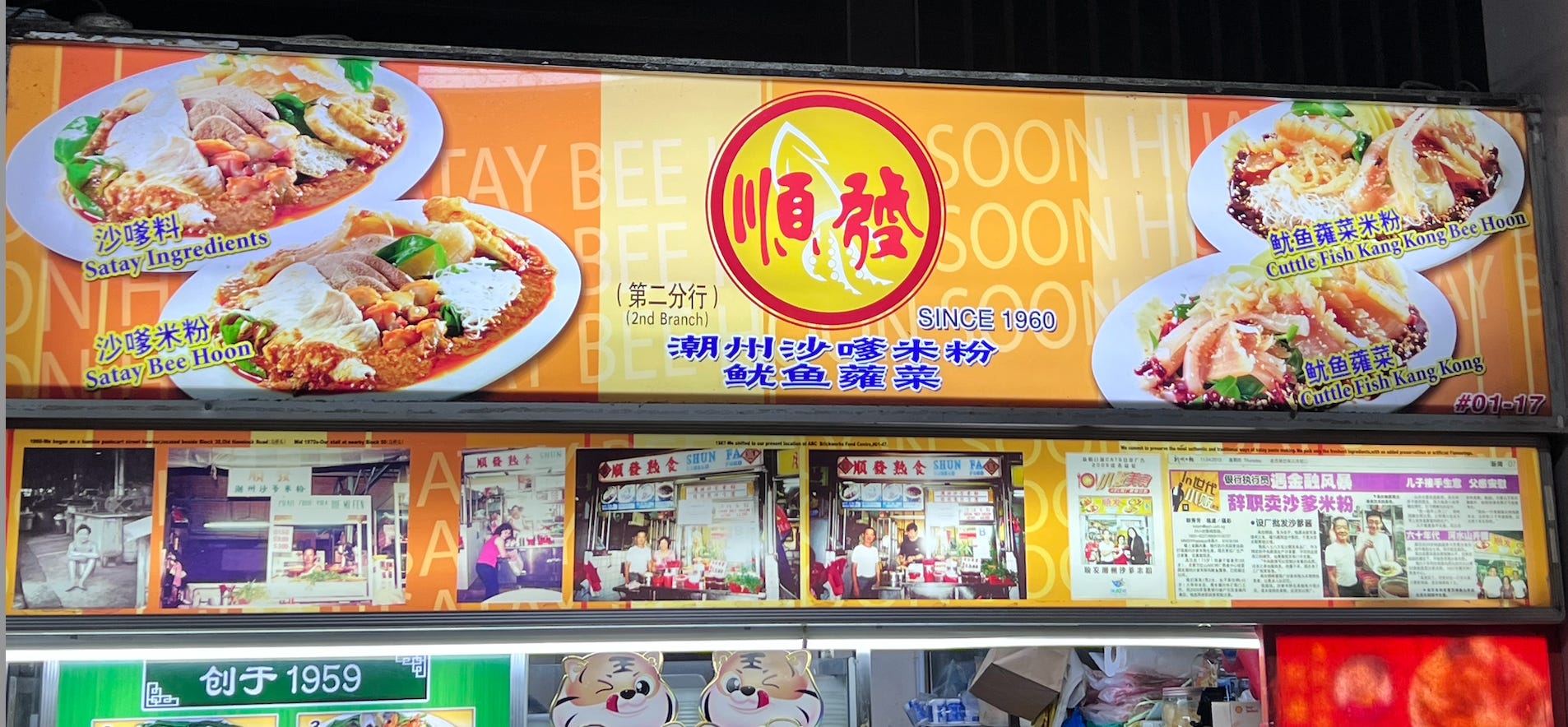
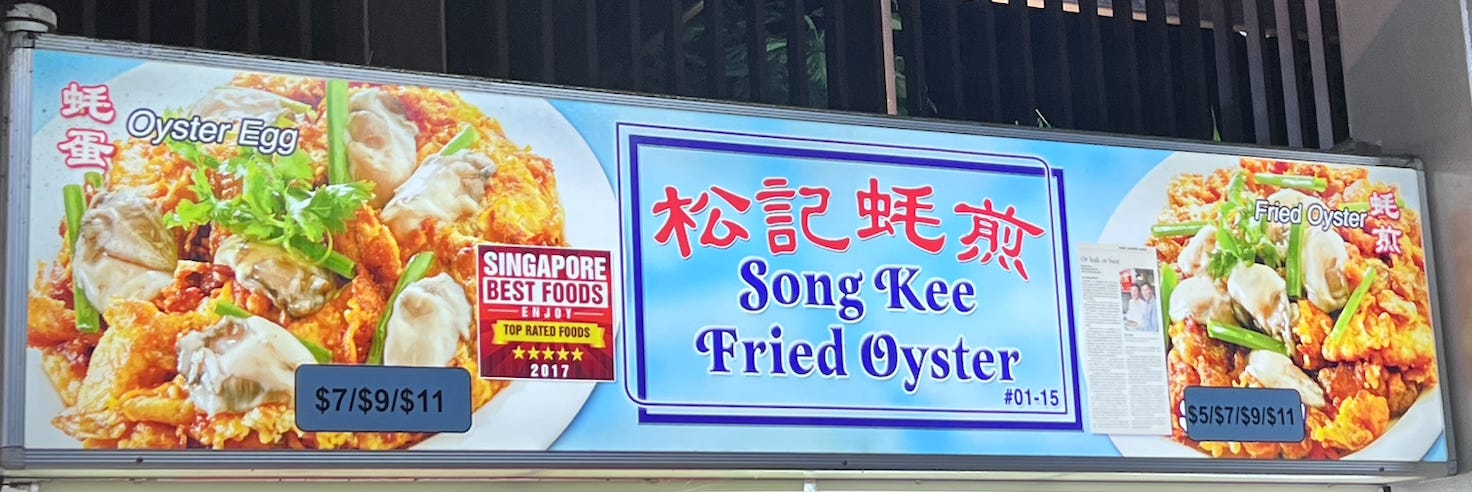

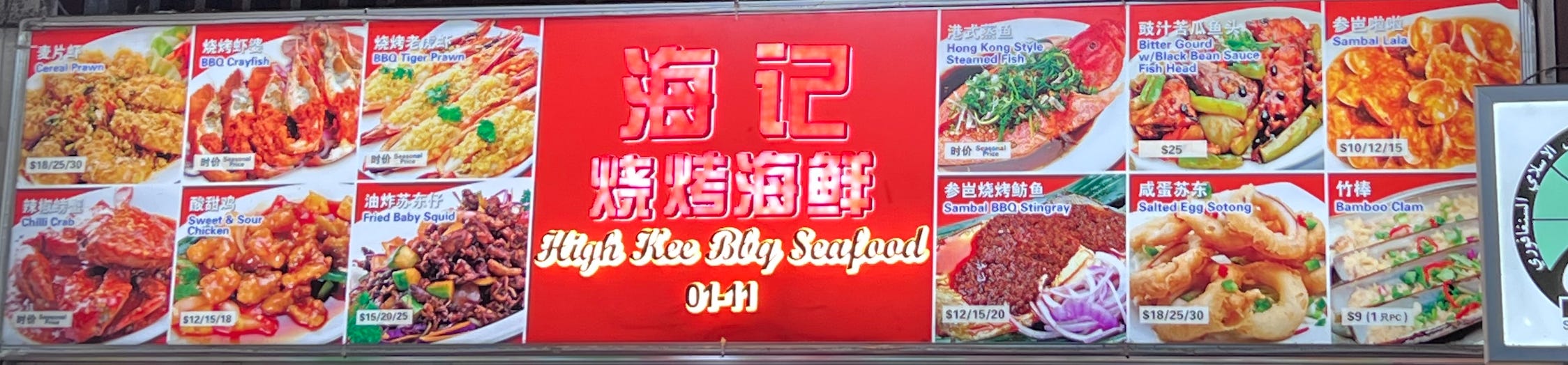
These stall names above are deeply influenced by their proprietors’ dialect roots – we do see some English, such as “fried oyster” and even “cuisine” – but their English names are typically romanised from dialect pronunciations of the Chinese characters. These names could form a majority of Singaporean Chinese hawker stalls in Singapore.
It doesn’t stop here – there are other naming styles as well. Pinyin names are also common, and I presume these stall owners were influenced by government initiatives to encourage Singaporeans to switch to pinyin in the 1980s. Do note, however, that the government did not (and does not) insist on particular naming conventions.
Two possible reasons Singaporean Chinese hawkers named their stalls in pinyin: they ordered their first signboard during the 1980s, or the hawker centre they were working at was renovated during that period of time; consequently, they could have decided to order a signboard in pinyin or switch over to it.
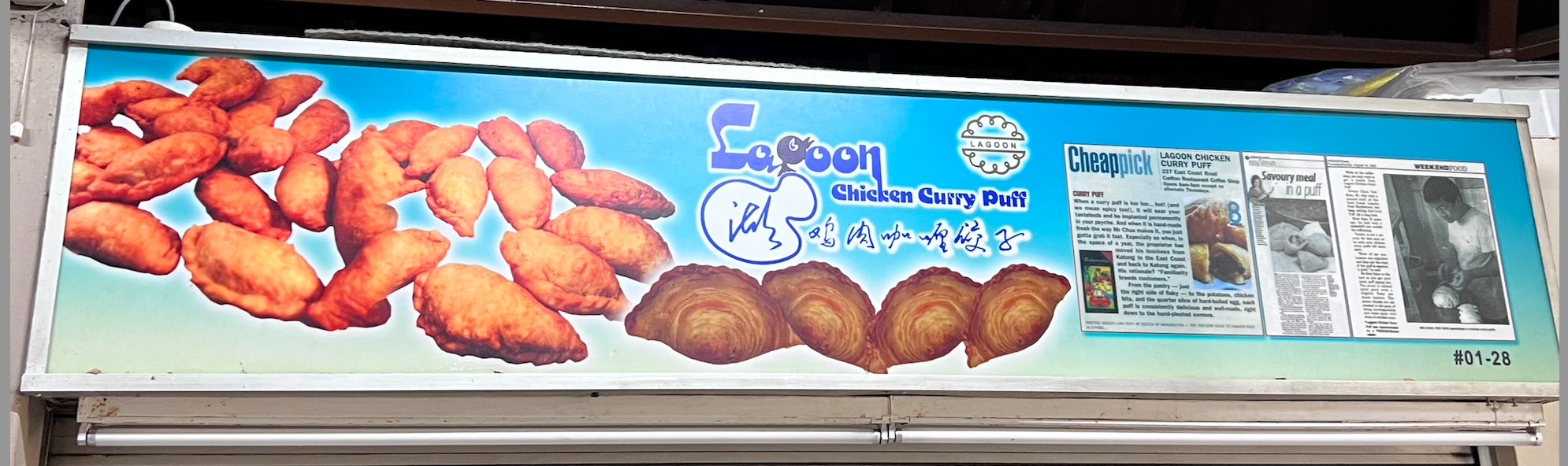
Another big reason for pinyin stall signboards: their owners could be first-generation immigrants from Mainland China, who immigrated recently. Think mala xiangguo (麻辣香锅) or other 川菜. As such, they could be unfamiliar with the dialect pronunciations of certain common names here, such as Heng, Huat or Hock. Instead, they might use pure pinyin, such as those below. Others, like the famous Lagoon curry puff, choose to translate “Chicken Curry Puff” entirely, scoffing at the more ubiquitous “咖喱卜”. Some may do away with the English name, although this might turn away non-Chinese speaking customers (see 作记 below). Given Singapore’s increasingly globalised status, it is now normal to see people who are ethnically Chinese, but do not speak or read Chinese, owing to their international school backgrounds.
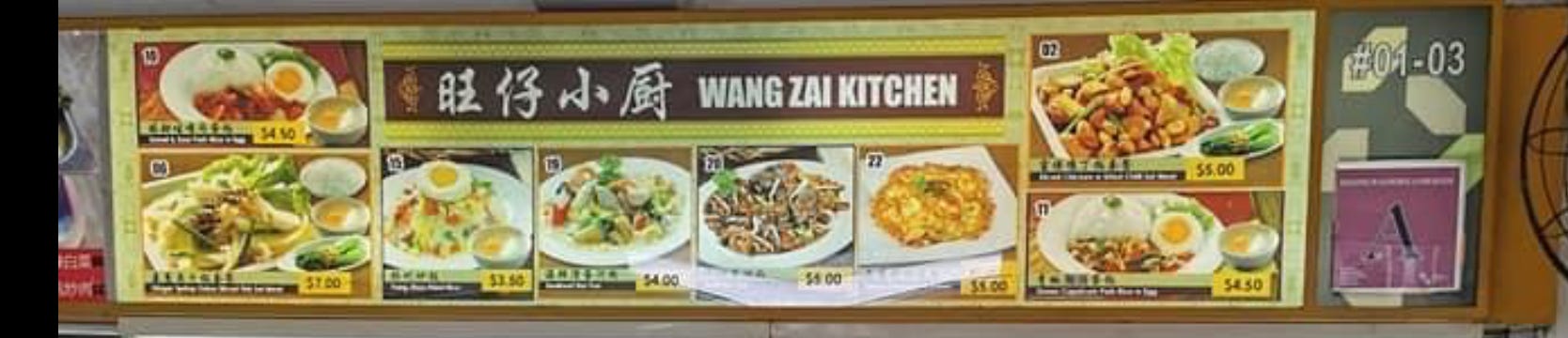
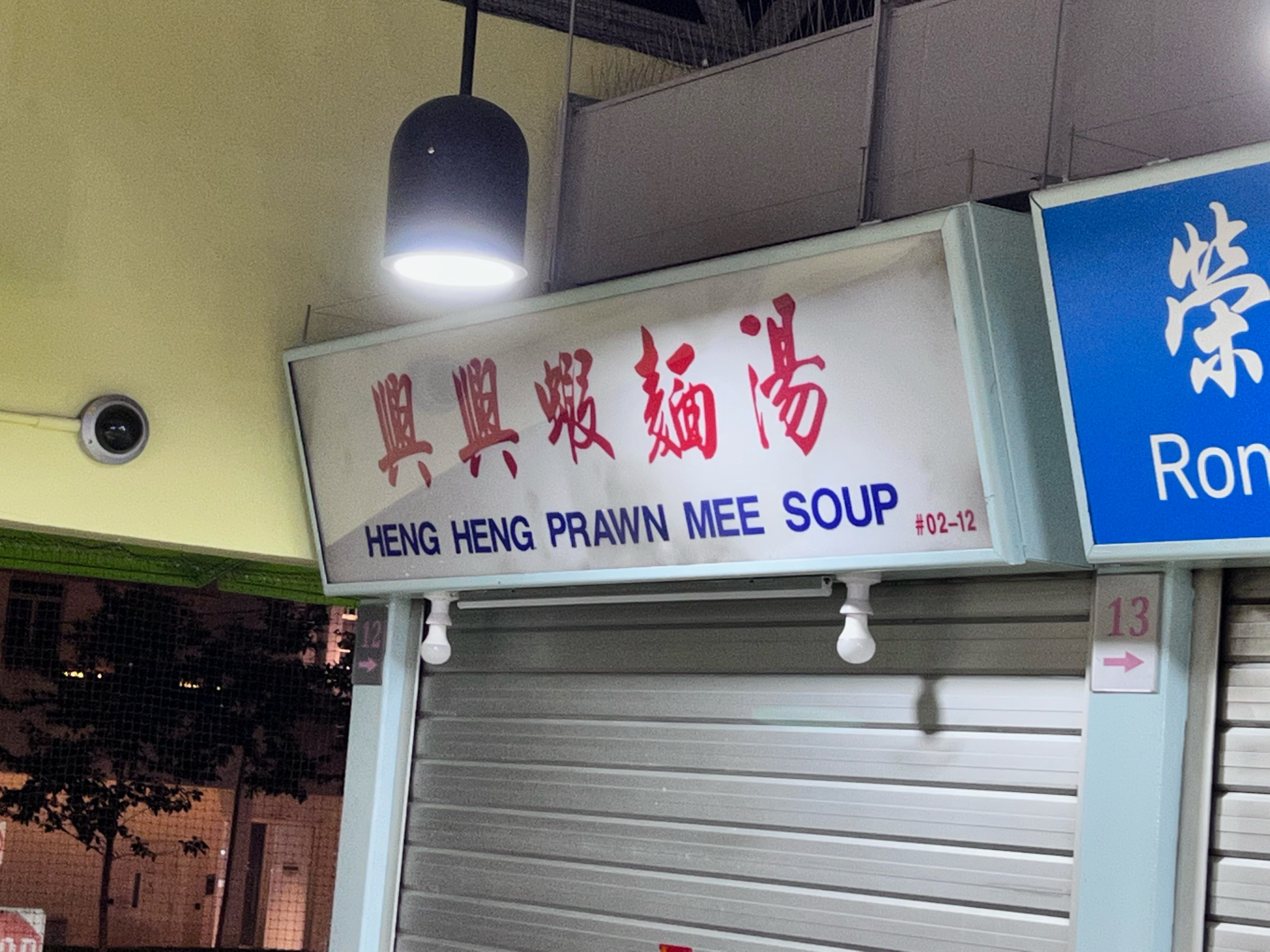
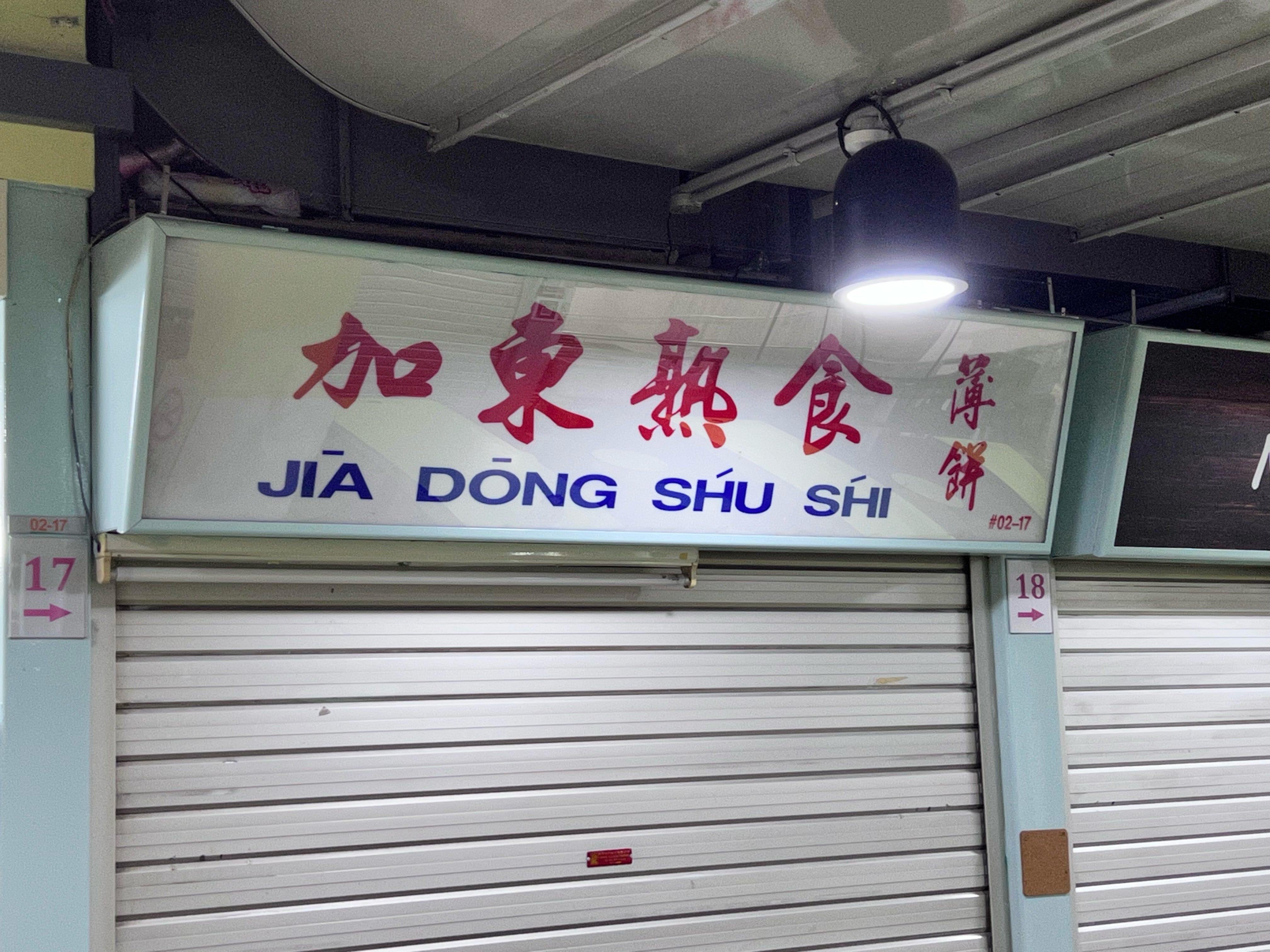


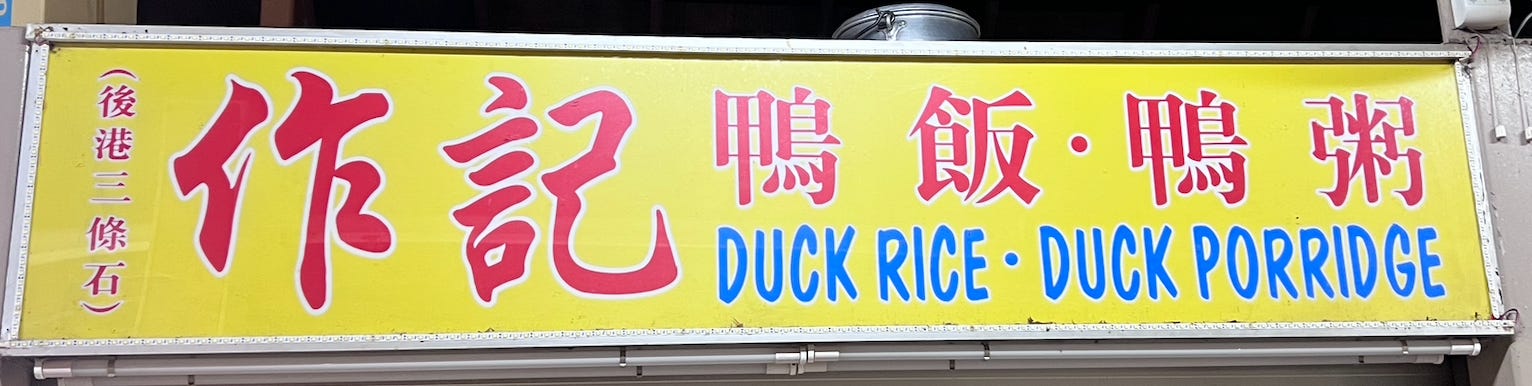
Substack is telling me to stop here, so I’ll leave the rest to the next post.
Some questions for next time: How do dialects vary in hawker stall naming? Can you tell which stalls are Cantonese? Where are the Hakkas and the Hainanese? Why do people put place names like “Somerset” in their signboards, even though they are now in Mountbatten?
See you next time. In the meantime, please enjoy these interesting terms:
“Ah Huay”
Chrysanthemum tea (not 花姐/LBW)
“Ang Ji Kow”
Hokkien “red-tongued dog”
Stout beer
“Pepsi siu dai”
Pepsi Light
“Coke kosong”
Coke Zero
Also affectionately but inaccurately referred to by Dunmanians as “Kampong Arang”, after the neighbouring Kampong Arang Road. Also, did you know that Jalan Batu isn’t a real road? Now you know.
NEA runs the tender system for hawker centres. The man who works at the “bak chor mee” stall I frequent, someone I refer to as 小弟 because he calls me 小弟, told me that he wanted to venture out on his own (he’s presently a salaried worker). He tried bidding for another Jalan Batu stall, but was outbid by $1. The tender process is extremely transparent and many documents are available on the NEA resources website. But it’s insane. There are people who are bidding $1 for a stall and end up successfully tendering the stall. They pay $36 for 36 months of rent.
Kong, L. (2007). Singapore Hawker Centres: people, places, food. National Environment Agency.